
Few household problems are as frustrating — or as urgent — as a garage door that won’t close. Whether it reverses just before reaching the ground, stops halfway down, or simply refuses to move at all, a garage door that won’t close leaves your home unsecured and exposed. The good news is that many of the most common causes are easy to identify and, in some cases, easy to fix on your own.
Below are 7 practical fixes to try right now, ranked from the simplest to the more involved. If you work through all of them and the problem persists, it is time to call in a professional for garage door sensor repair, motor repair, or a full diagnostic.
Fix 1 — Check and Clean the Photo-Eye Sensors
The most common reason a garage door won’t close is a problem with the safety sensors. These are the small units mounted a few inches off the ground on either side of the garage door frame. They project an invisible beam across the opening. If anything interrupts that beam — or if the sensors are dirty, misaligned, or malfunctioning — the opener will refuse to close the door as a safety measure.
Here is what to check:
- Look at the LED indicator on each sensor. Both should glow solid — a blinking light means the beam is broken or misaligned
- Wipe each sensor lens gently with a dry, soft cloth to remove dust, dirt, or cobwebs
- Loosen the mounting wing nut on the misaligned sensor, carefully adjust it until both LEDs glow solid, then re-tighten
- Make sure no object — a broom, a trash can, a garden hose — is sitting in the door’s path and breaking the beam
If both sensors appear clean and aligned but the door still won’t close, the sensors themselves may be damaged or their wiring may be faulty. That calls for professional garage door sensor repair from a trained technician who can test the circuit and replace components if needed.
Fix 2 — Clear Any Obstructions in the Door’s Travel Path
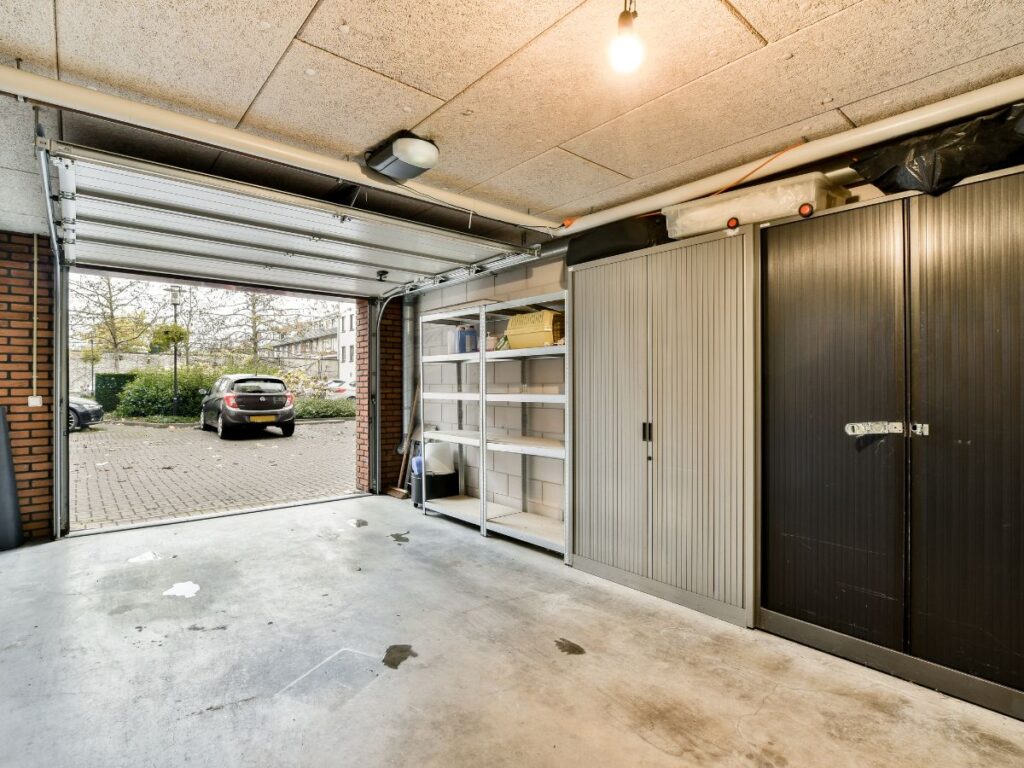
Before assuming a mechanical issue, walk the full length of both sides of the door and examine the floor beneath it. Even a small object directly under or alongside the door can trigger the safety reversal system and prevent closure.
- Remove any items within six inches on either side of the door’s path
- Check the floor along the bottom seal for accumulated leaves, ice buildup, or small debris
- Look along the tracks for anything wedged in the channel — pebbles, hardened grease, or a fragment of broken hardware
This takes less than two minutes and is easily overlooked when you are focused on the mechanical side of the problem.
Fix 3 — Adjust the Close Limit Settings on the Opener
Your garage door opener has a ‘close limit’ setting that tells the motor how far to travel before it considers the door fully shut. If that limit is set too short, the door will stop before reaching the floor. If it is set too long, the door will touch the ground and then reverse — because the motor interprets that resistance as hitting an obstacle.
- Locate the limit adjustment screws on your opener unit — usually labeled ‘Down’ or ‘Close’
- Turn the screw in small increments, no more than a quarter turn at a time
- Test the door after each adjustment until it closes fully and smoothly without reversing on contact with the ground
If you are unsure about adjusting your opener’s limit settings, or if the door continues to reverse even after adjustments, the opener may have a failing motor or drive mechanism. Our garage door motor repair and opener adjustment service covers full opener diagnostics and calibration so you do not have to guess.
Fix 4 — Reconnect the Trolley After an Accidental Disconnect
Most garage door openers have a red emergency release cord hanging from the trolley rail. Pulling this cord disconnects the door from the drive mechanism — a useful feature during power outages, but one that leaves the opener non-functional until the trolley is reconnected. If someone in your household pulled the cord recently, or if it was yanked accidentally, the opener motor will run but the door will not move.
- Pull the red release cord back toward the opener unit — this re-engages the trolley on many models
- Alternatively, manually pull the door closed and then reconnect by tugging the cord toward the door until you feel it click back onto the carriage
- Test the opener with the wall button or remote once the trolley is engaged
This takes under a minute and resolves the problem completely when the disconnect is the cause.
Fix 5 — Inspect the Tracks for Damage or Debris
The metal tracks on either side of the door guide its movement from fully open to fully closed. If the tracks are bent, warped, or clogged, the door may bind partway through its travel and fail to complete the close cycle.
- Visually inspect both tracks for visible dents, bends, or gaps at the joints
- Wipe the inside of each track channel with a damp cloth to clear built-up grease or debris
- Use a level to check whether the vertical sections of the track are truly plumb
Light debris inside the track is a quick homeowner fix. But bent or misaligned tracks are a different matter — forcing the door through a distorted track causes wear on rollers, hinges, and cables. See the track realignment and garage door repair services we offer in LaGrange County to schedule professional attention before the damage compounds.
Fix 6 — Look for a Broken Spring or Snapped Cable
If your garage door won’t close and it is hanging unevenly, or if you heard a loud bang from the garage recently, a broken spring or snapped cable is likely the cause. These are the two components that bear the actual weight of the door, and when either fails, the door can become entirely non-functional.
Warning: Do not attempt to repair broken springs or cables yourself. Both are under extreme tension and pose a serious risk of injury without the proper training and tools.
- Look above the door opening for the torsion spring — a break will appear as a visible gap or separation in the middle of the coil
- Check the cables on both sides of the door for fraying, unspooling, or complete detachment
- If you spot either of these issues, stop using the door immediately and call for emergency repair
Springs and cables are not DIY repairs. Our emergency spring and cable repair service at LaGrange County Door is available for same-day response — because a door with a broken spring is a door that should not be operated.
Fix 7 — Reset the Opener and Check the Remote Battery
Sometimes the simplest explanation is the right one. A depleted remote battery, radio frequency interference, or a glitched opener control board can prevent the door from responding — even when every mechanical component is in perfect condition.
- Replace the batteries in your remote and try again
- Test the wall-mounted button separately — if the wall button works but the remote does not, the issue is the remote, not the opener
- Unplug the opener from the wall outlet, wait 30 seconds, and plug it back in to perform a hard reset
- Check whether any recently installed devices — LED light bulbs, new Wi-Fi routers, or baby monitors — may be interfering with your opener’s radio frequency
Some opener models also have a factory reset option in the manual or on the manufacturer’s website, which can clear any corrupted programming.
When None of the 7 Fixes Work — Time to Call a Pro
If you have worked through every fix above and your garage door still won’t close, there is an underlying issue that needs professional diagnosis. Ongoing refusal to close can point to:
- Worn or cracked rollers that cause the door to bind in the tracks
- A failing opener motor that lacks enough drive force to complete a full close cycle
- Sensor wiring damage that cannot be resolved through cleaning or realignment
- Structural panel damage causing the door to rack and catch in the frame
How LaGrange County Door Can Help
Our technicians are trained to diagnose the full range of causes behind a garage door that won’t close — from simple sensor misalignment to failed motors to broken springs. Explore our full garage door repair services in LaGrange County to see everything we cover, or call us directly at (260) 367-1819 to schedule a same-day appointment.
If your door has been problematic for a while and repairs are adding up, it may be worth considering a replacement. Browse our residential garage door options to compare styles and materials, or ask our team for a replacement quote alongside your repair estimate.
Stop the Problem Today — Call LaGrange County Door
A garage door that won’t close is a security risk you should not leave unresolved. Whether the fix is a quick sensor wipe or a full motor replacement, the team at LaGrange County Door has the tools and experience to sort it out fast.
Call (260) 367-1819 today — same-day appointments are available throughout LaGrange County and Northeastern Indiana.
Call (260) 367-1819 — Garage Door Sensor & Motor Repair Available Today in LaGrange County